
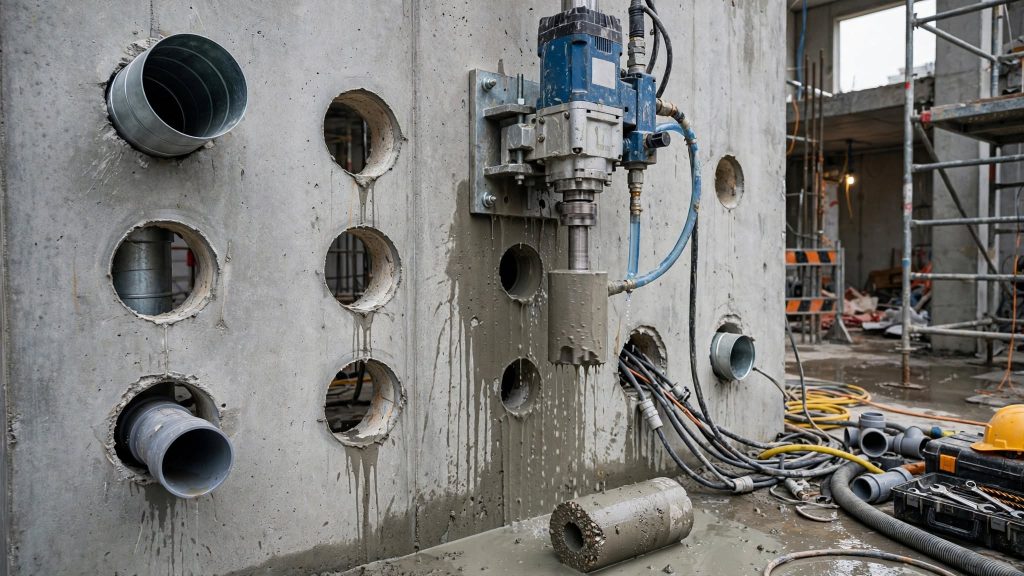
Modern buildings depend on networks of plumbing, electrical wiring, data cables, ducts, and ventilation systems. Installing these services often requires openings through concrete floors, walls, slabs, and other structural elements. Creating those openings accurately matters because poorly placed or irregular holes can complicate installation and cause unnecessary damage to surrounding material.
Core drilling provides a controlled way to form clean, circular openings in concrete and masonry. Using specialized drilling equipment and diamond-tipped core bits, contractors can create holes in specific diameters and locations while limiting disturbance to the surrounding surface. This makes concrete core drilling particularly useful for mechanical, electrical, plumbing, and HVAC installations.
What Is Core Drilling?
Core drilling is a concrete cutting technique that removes a cylindrical section of material rather than breaking or chipping away a larger area. A hollow core bit rotates against the surface and gradually cuts around the perimeter of the required opening.
Once drilling is complete, the cylindrical section, commonly called the core, can be removed. The result is a relatively smooth and accurately sized opening that can accommodate pipes, conduits, cables, ducts, or other building services.
Diamond core bits are commonly used because they can cut dense materials such as reinforced concrete, brick, block, and masonry. Depending on the project, drilling may be performed vertically, horizontally, or at a planned angle.
Why Precision Matters When Creating Service Openings
An opening for a pipe or cable is rarely placed randomly. Building services must follow planned routes while avoiding structural components and existing utilities.
A hole that is too small may require additional cutting, while an unnecessarily large opening can leave excessive clearance around the installed service. Incorrect positioning can also create conflicts with reinforcement, existing plumbing, electrical conduits, or nearby fixtures.
Accurate core drilling helps contractors work according to specified dimensions and coordinates. Before drilling begins, the required diameter, drilling depth, location, and surrounding conditions should be reviewed carefully.
This controlled approach connects closely with the broader principles discussed in How Concrete Cutting Improves Safety and Efficiency in Construction Projects, particularly where accurate planning can reduce unnecessary alteration of existing concrete.
Core Drilling for Plumbing Pipes
Plumbing installations frequently require penetrations through concrete floors and walls. Water supply lines, drainage pipes, waste systems, and other plumbing components may need to pass between rooms or building levels.
Matching the Opening to the Pipe
Core drilling allows the opening diameter to be selected according to the pipe and installation requirements. Contractors can account for pipe size as well as any required sleeve, insulation, seal, or clearance.
For example, when a drainage pipe needs to pass through a concrete floor, a planned circular opening provides a cleaner route than attempting to create the penetration using repeated impact drilling.
The position is equally important. Before drilling, workers should confirm that the proposed opening will align correctly with the plumbing route on both sides of the slab or wall.
Creating Openings for Electrical and Communication Cables
Electrical systems can involve individual conduits, grouped cable runs, data lines, security wiring, and communication infrastructure. These services often need carefully positioned pathways through concrete barriers.
Core drilling can create openings for conduit systems without removing more concrete than necessary. Several smaller penetrations may also be used where separate routes are needed for different services.
However, drilling should not begin solely from measurements shown on a drawing. Existing buildings may contain concealed electrical lines, pipes, reinforcement, or post-tensioning components. Appropriate site investigation and scanning can help identify hidden elements before a drilling location is approved.
Using Core Drilling for Ventilation and HVAC Systems
Ventilation installations generally require larger openings than individual cables or small pipes. Exhaust systems, air ducts, vents, and HVAC connections may need to penetrate concrete walls, ceilings, or floors.
Core drilling is useful when a round opening matches the shape and dimensions of the required duct or ventilation component. Examples include bathroom exhaust routes, mechanical ventilation penetrations, and openings for certain air-handling connections.
The required hole size should be determined from the actual installation specifications rather than estimated on site. Contractors may also need to consider insulation, sleeves, fire-stopping materials, seals, or other components that occupy space around the duct.
How a Core Drilling Job Is Planned
Accurate results depend on preparation as much as the drilling equipment itself. A typical job begins by identifying the exact purpose and dimensions of each penetration.
Important checks may include:
- Confirming the required hole diameter and depth
- Marking the center point accurately
- Checking both sides of the drilling area where accessible
- Identifying reinforcement and concealed building services
- Selecting a suitable core bit and drilling setup
- Planning for water, slurry, dust, and core removal
Wet core drilling may use water to cool the cutting surface and manage dust. Where water use is unsuitable, other drilling and dust-control arrangements may be considered according to the material and work environment.
Benefits of Core Drilling for Building Services
One important advantage of core drilling is control. Instead of producing an irregular opening through impact-based removal, the process follows a defined circular path.
It can also be useful where finished dimensions matter. Pipes, sleeves, conduit, and ventilation components can be installed through openings planned around their actual size.
Another practical benefit is versatility. Core drilling can be performed on different concrete and masonry surfaces and can accommodate a range of opening sizes. This makes it relevant during new construction as well as renovation, maintenance, and building-services upgrades.
Limitations and Important Considerations
Core drilling still requires careful planning. Reinforced concrete may contain steel bars, while some structures include post-tensioned elements that require particular attention before any penetration is made. Existing utilities can create additional risks if their locations are unknown.
Access can also affect the drilling setup. Restricted working space, drilling orientation, wall thickness, nearby equipment, and the condition of the concrete may influence how the work is approached.
The opening itself is only one part of the installation. Depending on the application, penetrations may require sleeves, sealing, waterproofing, fire stopping, or finishing after pipes, cables, or ducts are installed.
Conclusion
Core drilling provides a practical method for creating precise openings for plumbing, electrical, communication, and ventilation systems. By removing a controlled cylindrical section of concrete or masonry, it allows building services to pass through walls and floors with less unnecessary material removal.
Successful core drilling starts with accurate measurements, awareness of concealed structural and utility elements, suitable equipment, and consideration of the final installation requirements. When these factors are addressed before drilling begins, contractors can create clean, appropriately sized penetrations that support efficient installation while preserving the surrounding surface.