
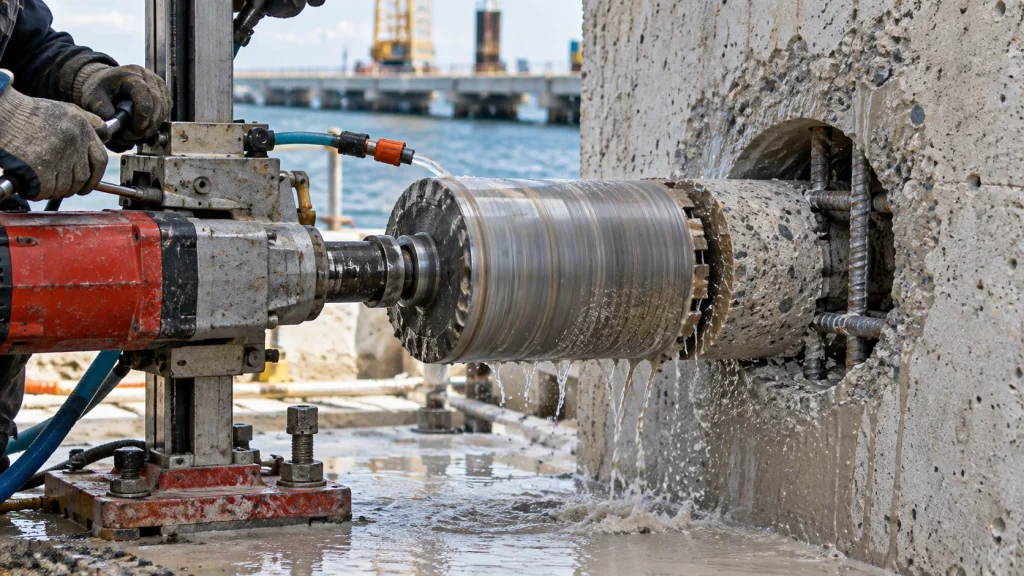
A hole through reinforced concrete may look simple on a drawing. In practice, the drill must cut hard aggregate and steel reinforcement while keeping the opening in the right place. Diamond core bits make that possible by removing a cylindrical section of material, or core, rather than breaking out the entire opening. Understanding how the bit works helps explain why diameter, reinforcement, cooling and access all matter before drilling begins.
How a diamond core bit cuts concrete
A diamond core bit is a hollow metal tube with diamond-bearing segments at its cutting edge. As the bit rotates, those segments grind a narrow ring through the concrete. The centre remains largely intact until the cylindrical core is removed.
The diamonds are held in a metal bond that wears gradually during use, exposing fresh cutting points. A suitable bit needs to cut the concrete’s aggregate as well as any steel it encounters. The combination of materials makes reinforced concrete more demanding than plain masonry: progress can change suddenly when the cutting edge reaches a reinforcing bar.
Core drilling is often chosen where a controlled, accurately placed hole is needed in a wall, floor or slab. It generally creates less impact and vibration than methods that rely on hammering. That does not mean drilling has no effect on the structure. The position of the hole and the reinforcement it intersects still need careful consideration.
Choosing a bit for the actual opening
The finished hole size should be based on what must pass through it, including any sleeve, insulation or fitting. A pipe’s stated size may differ from the outside dimension of the assembled part. Confirming that dimension before choosing a bit avoids an opening that is too tight or unnecessarily large.
Several conditions influence bit selection and drilling performance:
- Diameter: A larger hole removes more material and calls for equipment suited to the bit and the structure.
- Depth: The bit and drilling setup must reach through the wall or slab, with a plan for removing the core.
- Material: Concrete density, aggregate and the amount of reinforcement affect how the bit cuts.
- Access: Working overhead, close to a corner or beside existing services can limit how the rig is positioned.
A bit intended for another material may cut poorly or wear quickly in reinforced concrete. Segment design and bond also affect how readily the cutting edge stays exposed.
What happens when the bit reaches steel
Reinforcing bars strengthen the concrete, but a diamond core bit can encounter them in the path of a planned hole. Steel generally cuts differently from the surrounding concrete, so the operator may need to adjust the feed rate and allow the bit to work steadily. Forcing it can strain the equipment or damage the cutting segments; stopping at every change in resistance can also interrupt an otherwise controlled cut.
More importantly, a bit’s ability to cut steel does not mean a reinforcing bar should be cut. In a load-bearing wall or slab, the structural implications of an opening must be assessed before drilling. Where appropriate, the responsible designer or engineer should approve the location. Checking drawings and locating concealed reinforcement and services can help inform that decision, though findings still need to be interpreted in the context of the structure.
Consider a ventilation duct planned through an existing concrete wall. Moving the hole slightly may avoid a dense area of reinforcement while still serving the duct route. If the proposed wall is load-bearing, however, that adjustment should follow a structural review rather than an on-site guess. The useful question is not only whether the bit can complete the hole, but whether that hole belongs there.
Cooling, slurry and a steady cut
Water is commonly used to cool the cutting edge and carry away the ground concrete as slurry. It can greatly reduce airborne dust at the point of cutting, but it also creates liquid waste that must be contained and collected. In an occupied building, protecting finishes and nearby equipment is part of preparing the drilling area.
The drilling rig needs stable support so the bit follows the marked line without wandering. The operator then applies a controlled feed as the segments cut. Excessive pressure does not necessarily speed the work; it may heat or bind the bit. Too little feed can also affect cutting. Changes in sound, resistance or slurry can signal that the bit has reached a different material or needs attention.
For a floor penetration in an existing building, the space below matters as much as the surface above. The core can release when the cut breaks through, and water may follow the opening. Securing the core and protecting the lower area make the operation easier to control and the cleanup more predictable. For more detailed information on this topic, read our guide on Select How Core Drilling Creates Precise Openings for Pipes, Cables, and Ventilation.
When core drilling fits the job
A series of holes may also be used as part of a planned cutting approach, but many adjacent holes are not automatically the best way to form a large rectangular opening. Concrete sawing or wire sawing may be more suitable when the task is to make a broad opening or cut through a thick structure.
Before work begins, confirm the purpose, position and finished diameter of each hole. Establish the slab or wall thickness, assess what may be embedded in it, and consider how the rig will be supported. Plan for water, slurry, the removed core and any occupied space on the far side.
A core bit is only one part of a successful opening. When its size and cutting characteristics suit the material, and the hole has been checked against the structure and surrounding services, it provides a controlled way to pass through reinforced concrete with the accuracy the installation requires.